Why No Two Sources Agree on Edina's Median Home Price
September 17, 2026
September 17, 2026
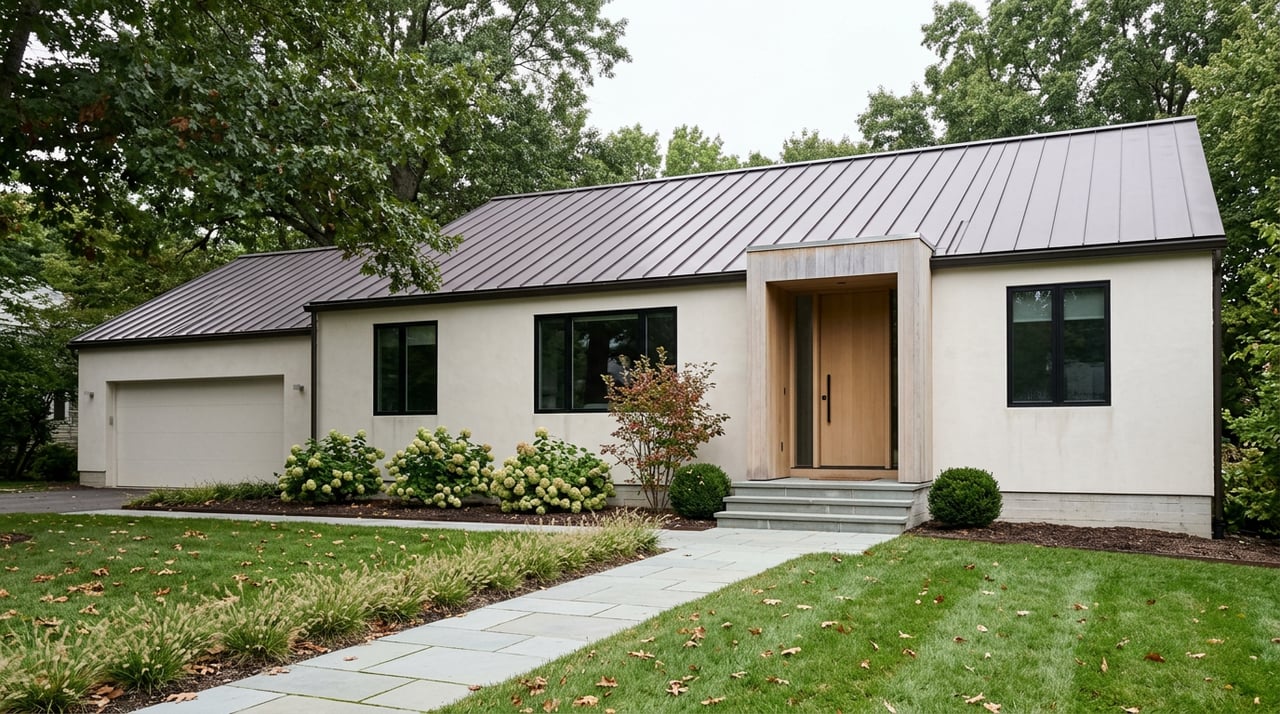
Drive the three blocks of Oaklawn Avenue near Pamela Park and you'll pass a 1950s rambler with a single-car garage, a house mid-framing with the sheathing still exposed, and a finished new build with a stone facade and a driveway wide enough for three cars. All three sit on lots roughly the same width. All three carry the same zip code and the same word on a listing sheet: house. A buyer who prices any one of them using Edina's "median sale price" is pricing something that doesn't actually exist on that block, because the number was never describing one product to begin with.
That's the trouble with Edina's median right now. Pull up several sources tracking the city in the same general window of 2026 and the figures spread from the high $500,000s to the high $700,000s, a gap wide enough to represent an entire additional house. That's not sloppy measurement. It's what happens when a single statistic tries to average two different things being sold under one address type: land with a disposable structure on it, and a finished, code-current new build.
One dataset pegged Edina's median at $580,000 in early 2026, drawing on Minneapolis-area MLS figures. A separate tracker showed $788,000 for February 2026, up a striking 25 percent year over year. A third source, looking at that same February, landed at $749,950. A fourth, measuring as of June 2026, put the median list price at $650,752.
Those aren't four different cities. They're four snapshots of the same city, taken with slightly different timing, methodology, and mix of what happened to close that month. When new-construction closings cluster in one reporting period, the median jumps because a handful of $1.3 million sales pull the middle upward. When more original-stock ramblers change hands in a slower month, the median drops back down, even though nothing about the underlying market shifted. The volatility isn't noise to filter out. It's the signal. Edina's housing stock is bifurcated enough that a monthly median tells you more about which type of home happened to sell that month than about what a typical Edina home costs.
Here's the mechanism underneath the number. Much of Edina's housing was built in the 1940s and 1950s, when Cape Cods and ramblers were the standard for the growing inner-ring suburb. Many of those homes are now smaller than what today's buyers are searching for, sitting on lots that were platted before anyone anticipated three-car garages or primary suites. When one of those homes sells, its listed price is mostly a land price. The structure itself, worth little on its own, is often demolished within months.
At the same time, a meaningful share of Edina's annual sales are recently completed new construction: homes built on those same lots after the old structure came down, priced against current construction costs rather than against the neighborhood's older stock. Custom construction in Edina commonly runs $300 to $450 per square foot before land, and all-in project budgets for a full teardown-and-rebuild regularly reach seven figures. A finished new build and the rambler it replaced can sit on the identical lot, a year apart, and be priced hundreds of thousands of dollars apart with no contradiction. They were never the same product.
The city's own residential redevelopment activity gives a sense of how much of this is happening at any given time. Edina's redevelopment turnover has run at roughly 100 homes a year, close to 1,000 over the past decade, concentrated in specific neighborhoods rather than spread evenly across the city. That volume is high enough that in any given reporting month, the mix between "land sale" and "finished new build" can swing the median by tens of thousands of dollars without any change in what a buyer's dollar actually buys.
No neighborhood illustrates this better than Pamela Park, which a Star Tribune investigation identified as the epicenter of Edina's teardown activity. The reporting followed Andy Porter, co-owner of the building company Refined Custom Homes, who had built his own home in the neighborhood and gone on to construct more than a dozen others nearby. By the time that story was reported, Refined had built or was building seven homes on a single three-block stretch of Oaklawn Avenue alone, with several more lots lined up.
What makes the story useful for a buyer today isn't the specific count, which will have shifted since. It's what Porter said about how quickly the neighborhood's economics moved:
"Five years ago, if you asked somebody to spend a million dollars here, they would have laughed at you."
That's the pattern in one sentence. A neighborhood priced for its structures got repriced for its lots, and the transition happened faster than most buyers watching from outside would have guessed. Pamela Park sits between the 50th and France shopping district and Southdale, bordered by some of Edina's largest parkland, which is exactly the kind of location premium that makes a lot valuable independent of what's currently built on it.
Not every Edina neighborhood plays by Pamela Park's rules, and that's the part a median obscures completely.
Three neighborhoods, three different relationships between the price of dirt and the price of a finished home. A buyer comparing "Edina" to "Edina" without knowing which of these dynamics applies to a specific block is comparing figures that were never built the same way.
Before a price per square foot means anything, ask what's actually being priced. A listing agent can tell you whether recent nearby sales were land plays or finished-home sales, and whether the specific lot you're considering sits in a pocket where teardown activity is active or one where it's constrained by lot character or district expectations.
If you're buying next to an active or planned teardown, it's worth understanding Edina's Construction Management Plan, which governs allowed construction hours, signage, and complaint procedures for residential demolition and new-build projects. That's not a hypothetical concern in a city with this much annual turnover. It's the kind of detail that changes what living next to a project for a year actually feels like.
And if you're the one considering a teardown, run the math the way builders do: what would a finished new home sell for on that specific block, then subtract demolition, permits, financing, and construction, which commonly lands at $300 to $450 per square foot before land costs. What's left is roughly what the lot itself can support, independent of whatever the current structure is worth.
Does a lower price per square foot always mean a better deal in Edina? Not on its own. A lower number can mean an older structure priced mostly for its lot, which may need six figures of construction investment to reach the finish level of a comparable new build a block away. Compare against what you'd actually be buying, not just the number.
How can I tell if a listing is functionally a land sale? Build year, recent comparable sales on the same block, and whether nearby lots have seen new construction in the past few years are the clearest signals. Your agent can pull that history for a specific address before you tour it.
Do all Edina neighborhoods allow the same kind of rebuild? No. Historic districts and neighborhoods with established character guidelines shape what a new structure can look like, while other pockets have fewer constraints. That difference belongs in your search criteria from the start, not something you discover after falling for a lot.
Edina's median will keep moving month to month, and that's fine. It was never meant to describe a single kind of home. What matters is knowing, block by block, which version of Edina you're actually pricing.
If you're weighing a specific Edina neighborhood, or trying to figure out whether a listing you're watching is priced as a house or as a lot, Molly Cardinal can walk the comparables with you street by street. Request a home valuation to start the conversation with real numbers for your specific block, not a citywide average that was never describing your street to begin with.
Stay up to date on the latest real estate trends.
Molly is passionate about helping her clients find their perfect home and bringing clarity to real estate transactions. She drives the home search through education, communication, and honesty, creating an environment where clients feel comfortable asking questions and expressing their goals they are able to reach together.